


Customer behavior changing to avoid Fin | Community
Skip to main content
Question

Customer behavior changing to avoid Fin

  • May 27, 2026
  • 4 replies
  • 352 views

Adam Bengal
Forum|alt.badge.img

Hello Intercom Community!

We have been live with Fin for just over a year now. We began small with a subset of beta users, then went live with all users on our Cloud platform on January 1st 2026. While there are bumps and dissenters, overall the reception was positive and we saw steady growth/use AND witnessed a direct decline in the number of support cases, which is one of the primary goals.

HOWEVER. We seemed to have plateaued and are now seeing a change in Customer behavior as users are actively avoiding Fin: while the number of daily chats remains about the same (as we are adding new users weekly), we have seen a steady increase in our support call and email volume over the last 2-3 months (see the below chart which clearly shows this shift in behavior; Fin is replacing the ‘In-app’ support channel, but notice how the Call and Email channels are now steadily increasing).
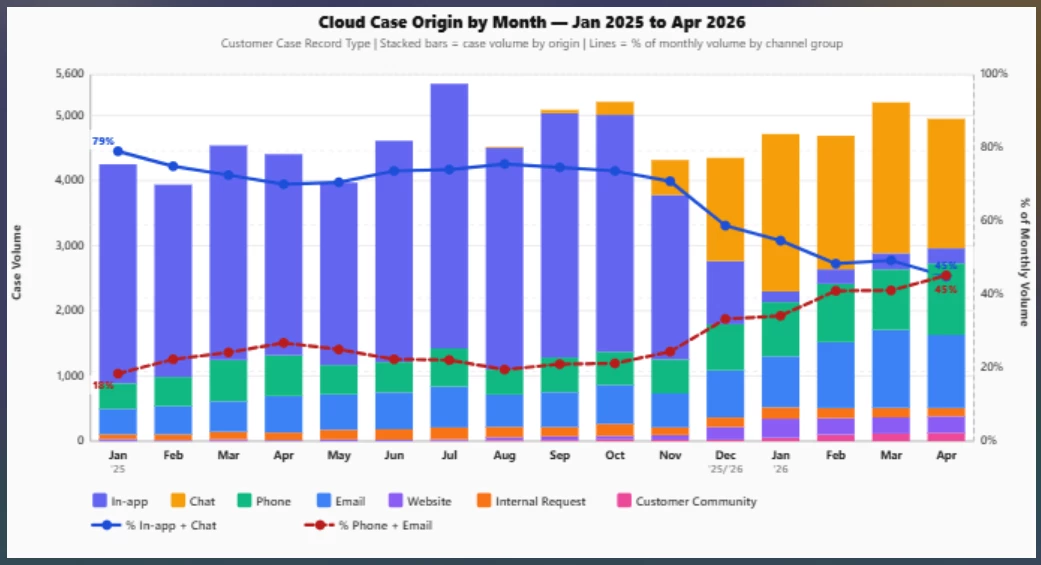
Note: We currently have Fin setup to only act as a ‘first line of defense’ on questions, and he does NOT interact  with our emails or ServiceCloud cases in general (only creates the case when an escalation is needed). 

Has anyone else witnessed this type of shift? Any ideas on how to improve this?

4 replies

Forum|alt.badge.img+3
  • Active User
  • May 29, 2026

Are you seeing that users who are now reaching out over email or phone are users who previously tried to interact over chat? It would be interesting to see if they’ve tried one and decided to go another path because they didn’t like the answer they were getting. It could also be that the volume shift from channel to channel could be another customer segment. I would start by analyzing the reason customers are reaching out from email and phone and see if there is a content gap. The Analyze Tab under Fin would be helpful here in identifying part of what’s making the shift happen. 

That being said, I would also enable Fin over email. If the bulk of the questions can be solved by Fin, let Fin solve them, and make sure it’s easy for customers to transfer to a person when they ask.  


Adam Bengal
Forum|alt.badge.img
  • Author
  • New Participant
  • June 4, 2026

Are you seeing that users who are now reaching out over email or phone are users who previously tried to interact over chat? It would be interesting to see if they’ve tried one and decided to go another path because they didn’t like the answer they were getting. It could also be that the volume shift from channel to channel could be another customer segment. I would start by analyzing the reason customers are reaching out from email and phone and see if there is a content gap. The Analyze Tab under Fin would be helpful here in identifying part of what’s making the shift happen. 

That being said, I would also enable Fin over email. If the bulk of the questions can be solved by Fin, let Fin solve them, and make sure it’s easy for customers to transfer to a person when they ask.  

Thanks ​@Gerald Prado ! 

We have run some numbers and confirmed what we speculated: our longer-tenured customers use Fin the least (~30% less than customers who are ‘new’ within the last 3 years). 


As for the email side: this is something we want to pursue eventually...but we’re weary of doing so now, as we don’t want to respond to their avoidance of using an AI tool with more AI...


Aleksei O
Super User ✨
Forum|alt.badge.img+5
  • Super User
  • June 12, 2026

Hi ​@Adam Bengal! This challenge you are experiencing is something I’ve also encountered in my previous org, where I was running Fin in combination with Workflows. My funnel looked similar to yours, where Fin was taking a first line of defence, utilising our knowledge base to generate answers, then assigning them to live support if the client was not happy with the reply. While a lot of the questions seemed to be easily covered by Fin, I’ve noticed that users were still looking for that human validation, and it was challenging to convince them that the answer Fin had generated was relevant for them. At that point, I’ve managed to reach a 46% resolution rate by building the Workflows in a way that human support is still accessible, but the client would still need to ask their question to the AI at all times. Naturally, not all users were happy with the approach, but with the help of my team, we were encouraging them to still try the solution offered by Fin, and sometimes it worked. Nowadays, I would say the key for Fin to sound more convincing is to utilise customer data in the responses and Procedures, so that the answers are more actionable and don’t sound generic. 


Christopher Boerger
Innovator ✨
Forum|alt.badge.img+4

@Adam Bengal ​@Aleksei O  great thread, and that longer-tenured user stat is really the key data point here.

The 30% gap between new and tenured users isn't surprising — it's actually a well-documented trust pattern. Newer users have no prior expectation of how your support *should* feel. Tenured users do. They built a relationship with your team over years, and Fin — however good — doesn't feel like that relationship. So they route around it.

A few things worth trying, roughly in order of effort:


1. Don't hide the human path — make it part of the flow

If tenured users feel like they have to "defeat" Fin to reach a person, they'll skip the channel entirely. The fix is to make human handoff a first-class option, not a fallback. In Workflows you can build a path that shows a "Talk to someone on our team" button *alongside* Fin's answer — Fin still handles it first, but the escape valve is visible and immediate. Aleksei's point about "human still accessible but question asked to AI at all times" is exactly right — it's about reducing the *perceived* cost of trying Fin, not forcing compliance.

The "Ask for more information before handover" setting in Fin's workflow config is also worth enabling — it creates a natural bridge where Fin gathers context before passing to a human, which actually improves the human agent experience too.


2. Address the trust gap with personalisation, not just content

Generic answers erode trust faster with tenured users because they *know* your product well enough to spot when an answer is boilerplate. Aleksei nailed this — using customer data in responses (account type, plan, usage history) via Fin's Data Connectors or Procedures makes answers feel specific and earns more trust than a well-written-but-generic article citation. Even something as simple as Fin referencing the customer's plan name in its response changes the perceived quality significantly.


3. Reframe the email concern

I understand the instinct — responding to "they're avoiding AI" with "more AI on email" feels tone-deaf. But I'd reframe it: the problem isn't AI, it's *uncontrolled* AI. Email is actually a lower-friction channel for tenured users precisely because they feel in control — they write on their terms and expect a considered reply. Fin over email, configured with a clear human handoff and a warm tone, can match that expectation. The key is making Fin's email replies feel like a thoughtful first response from your team, not an autoresponder. You can tune this heavily with guidance and persona settings.


4. Look at what Fin is *not* resolving for tenured users specifically

The Analyze tab will show you resolution rates, but try filtering or tagging conversations by customer tenure if you can. My guess is tenured users are asking a different *category* of question — more nuanced, more product-specific, less FAQ-shaped. That's a content/Procedures gap more than a trust gap. If Fin can't answer their questions, of course they go to phone.


5. Invest in how Fin sounds, not just what it knows

This one's underrated, especially for the tenured-user trust problem. Intercom published two pieces worth reading together on this.

The first, by Kate Sugrue on https://ideas.fin.ai/p/a-name-you-can-trust-the-case-for, looks at how customers form a trust judgement before they've even read Fin's first response — within seconds of seeing the agent's name and opener. She analysed naming patterns across thousands of Fin deployments and found that the right signal for a tech/SaaS context (like yours) tends to be functional and product-aligned rather than humanised — but the key insight is that this decision is rarely deliberate, and it should be.

The second, published this week by Intercom's Fred Walton on https://www.intercom.com/blog/conversation-design-for-your-ai-agent/, makes the business case for owning how your AI Agent communicates — not just what it knows. The stat that stood out: Intercom A/B tested two opening messages for Fin, one warm and conversational, one their old default. The conversational greeting lifted CSAT from 72.8% to 78.4% — a single change to the first thing a customer sees.

For your longer-tenured users who are actively avoiding Fin, the content gap may be less of the problem than the *experience* gap — the way Fin sounds compared to the team they've been talking to for years. Tone, response structure, how handoffs are communicated — these are all configurable through Fin's Guidance settings, and they don't require new knowledge, just someone who owns how Fin sounds. If nobody on your team has formally defined Fin's voice, that's probably worth doing before anything else.


Does yours have a name or is it fin?

---

Curious what the Analyze tab is showing as the top unresolved topics — that would tell you a lot about whether this is a trust problem or a capability problem (or both).