

Has anyone figured out a way to report on SLA based on Companies? | Community
Skip to main content
Answered

Has anyone figured out a way to report on SLA based on Companies?

  • February 14, 2025
  • 6 replies
  • 421 views

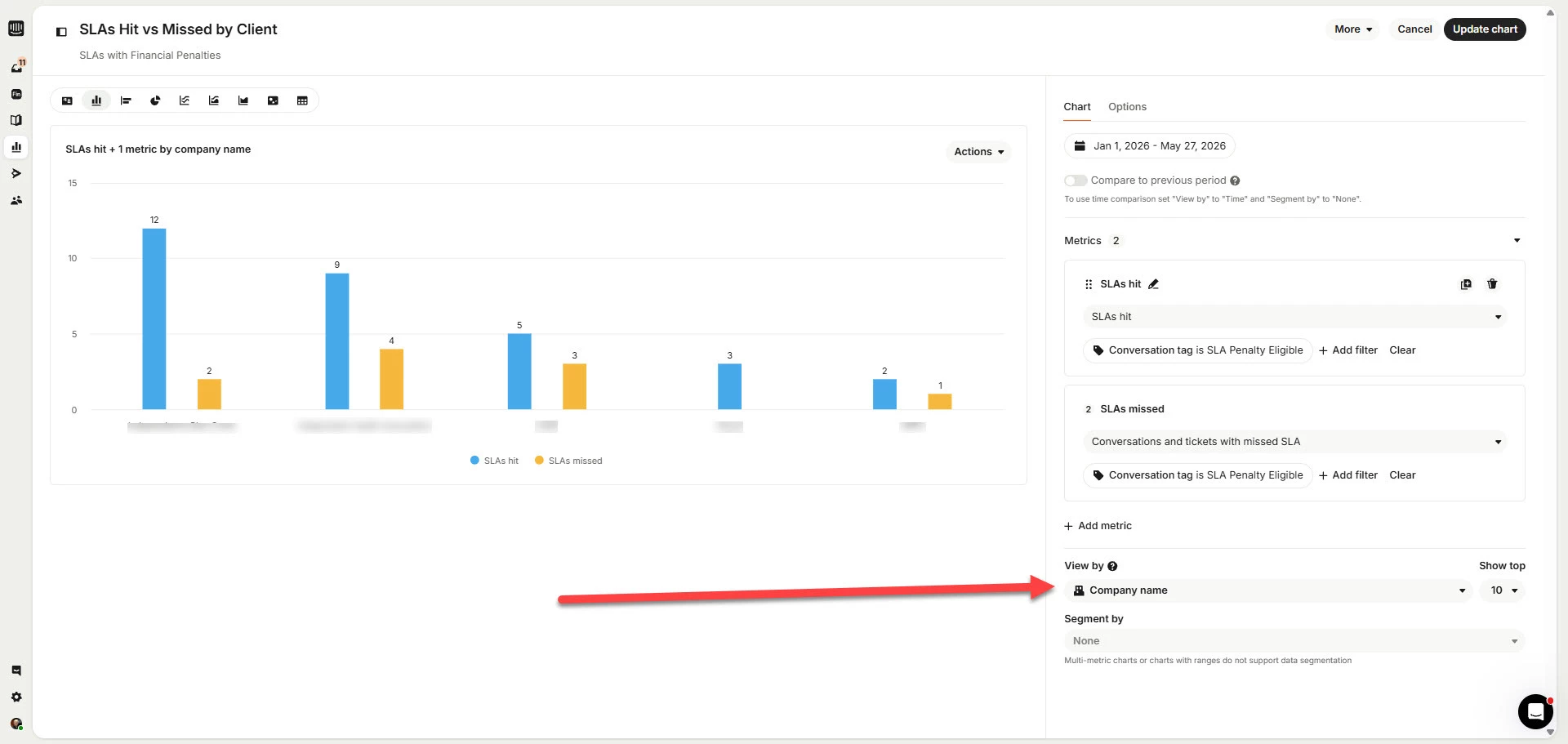
Turns out a “Company” filter doesn’t work in any of the SLA reports. Leaving you with no way to see the team’s performance for any of your clients. Or any other company related info, such as attributes.

I’m surprised a basic report is missing and was wondering if anyone has figured out a way to solve this.


Best answer by Sean Meade Forum Support Lead

Hi ​@Krasto Milchev, ​@Anne McHale, ​@robertdistefano, and ​@Sonal Raval,
 

Thanks for this suggestion! We take input from our customers with great consideration when creating new features and refining our current solutions. Did you know that you can check if this feature has been recorded on our Product Wishlist in our Community? You can search and upvote existing requests or create new requests 🙌


Check out the quick guide on how the Product Wishlist works here.


Note that you must be logged into the Intercom Community to access the Wishlist. You can log in with SSO or log in as a guest at the top right of the page.

6 replies

Paul Byrne
Intercom Team
Forum|alt.badge.img+7
  • Intercom Team
  • February 16, 2025

Hey ​@Krasto Milchev 


You're correct—Intercom's SLA reports do not currently support filtering by "Company" attributes. This means that tracking SLA performance per client (i.e., per company) isn't natively available in the reports.

I'll create a feature request on this one for you. 🚀 


  • New Participant
  • February 9, 2026

@Paul Byrne is this feature request one we can track or vote on? Interested in status and a link


robertdistefano

I’d like to reiterate the desire to have this feature added. It’s incredibly valuable (if not entirely necessary) for our organisation to be able to report on SLA adherence per company.

It’s not uncommon for us to receive requests from customers about our SLA hit/miss rate across their support tickets, and we have no reliable way to do so without the ability to filter by company (and by extension, things like region/country).


Forum|alt.badge.img+1
  • Active User
  • April 21, 2026

Tagging on that my company is also very interested in this functionality. It’s important for us to be able to pull SLA metrics by company.


This "average" performance often hides critical failures for our most important accounts.

  • Data Fragmentation: We can see that we missed 10% of our SLAs last week, but we cannot instantly see if those misses all belonged to one "Strategic-tiered" company or were spread across 3 lower-spend companies.
  • Manual Overhead: To get company-specific data on SLAs, the workarounds require to create hundreds of redundant user tags, or other user-level attributes, just to make them visible in reports. This would add a level of redundancy in our workspace that we are not interested in.
  • Reactive Account Management: Customer Success Managers and technical support leaders cannot easily review company-level SLAs to correct downward trends. 
  • Contractual Obligations: Customer Success Managers cannot review company-level SLAs to confirm contractual obligations are met.

Forum|alt.badge.img+5

Hi ​@Krasto Milchev, ​@Anne McHale, ​@robertdistefano, and ​@Sonal Raval,
 

Thanks for this suggestion! We take input from our customers with great consideration when creating new features and refining our current solutions. Did you know that you can check if this feature has been recorded on our Product Wishlist in our Community? You can search and upvote existing requests or create new requests 🙌


Check out the quick guide on how the Product Wishlist works here.


Note that you must be logged into the Intercom Community to access the Wishlist. You can log in with SSO or log in as a guest at the top right of the page.


robertdistefano

Hi ​@Sean Meade Forum Support Lead 

Yes, it has been submitted as an Idea already: 

I don’t think it’s fair to flag this question as answered when a solution hasn’t really been provided. It gives the community a false sense of action taken, when in actuality it hasn’t.